


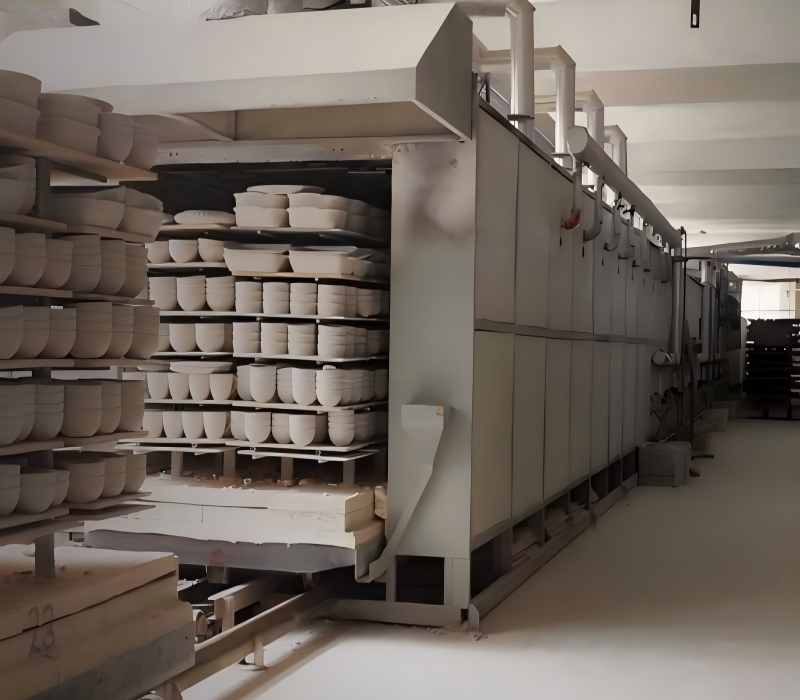



The Black Core Inside the Body: A Defect That Does Not Show on the Surface
A piece can leave the kiln with a perfect surface and a body that never finished becoming ceramic. Break it through the wall and you may find a grey to black band in the middle of the section, sitting between two skins of normal colour. Nothing outside predicted it: no glaze defect, no warp, no colour drift.
Products in this guide: Stoneware Ceramic Mug Matte Glaze · Ceramic Rice Bowl Minimalist White
The industry name is a black core. It is not cosmetic. A core that stayed carbon-rich is a body that did not complete the reaction that makes fired ware strong, so the wall is more brittle than the specification assumes and can fail much later. Yet every gate in a normal order passes it, because the evidence lives inside a wall nobody is allowed to break.
That is the awkward category for a buyer: a defect that is real, that a factory can prevent, and that neither side can see without destroying a piece. Here is the mechanism, why inspection cannot catch it, and the clauses that make it controllable. See the full ceramic sourcing process map.
What a Black Core Actually Is
Firing does two jobs at once. It burns out the organic material carried by the body, and it densifies the clay into a ceramic. The order matters: carbon has to leave before the body closes, because once the surface seals there is no route out.
When the seal happens first, carbon stays trapped in the middle of the wall. On a broken section it reads as a dark zone, sometimes a sharp band, sometimes a soft gradient fading outward. In severe cases the gas that could not escape pushes the body apart, and the piece bloats or laminates.
It is a firing outcome, not a bad batch of clay, though body and shape decide how much room for error exists.
Why the Surface Tells You Nothing
The outside of a wall fires first and fires clean. By the time the centre reaches temperature, the outer few millimetres are already dense, already white, already glazed. The defect sits behind the only surface an inspector can see.
Visual inspection is calibrated to what eyes can judge: colour, gloss, pinholes, specks, chips, warpage. None of those categories contains a condition four millimetres inside a wall. Tapping gives a duller note in severe cases, but it is not repeatable enough to serve as a line gate.
So it survives sampling and pre-shipment inspection, and the first evidence is a crack in a stacked carton.
What Makes It Form
Five conditions raise the risk.
Section thickness. A thick base, a solid handle, a heavy rim: the centre has further to travel and more carbon to clear. Thin-walled shapes are far less exposed, which is why the same body and kiln can produce both sound and unsound ware on the same day.
Ramp rate through burnout. The critical window sits in the middle of the firing, where carbon is being consumed. A schedule that climbs quickly through it saves hours and leaves carbon behind. A hold in that range costs time and clears it.
Loading density. Ware set too tightly restricts airflow and creates pockets where oxygen is locally scarce. This is decided by how full the car is on the day, not by the specification.
Body composition. More organic content, more plastic clay, or certain additions all demand more of the burnout stage. A recipe change made for plasticity or cost quietly raises the firing requirement.
Residual moisture at loading. Damp greenware must dry inside the kiln before it can heat, compressing the rest of the schedule.
What It Costs Downstream
The failure is not the piece you find. It is the piece you do not find.
- Strength. An unoxidised core has not developed the same bond, so impact and thermal load meet a weaker section than the design assumed.
- Delay. Cracks appear weeks after delivery, when nothing can be traced back to a kiln.
- Perception. A chip that exposes a dark core looks like contamination to the person holding the cup, whatever the laboratory says.
- Attribution. A complaint arriving eight months later cannot be assigned to a load, a shift or a batch unless a record was kept at the time.
The Gate That Does Not Exist
An AQL inspection samples surfaces. A cross-section check breaks the sample, so it cannot run on saleable goods and is almost never written into a specification. Most defect lists describe what is visible at inspection and stop there.
Without a clause, the factory has no obligation to look: a control nobody asked for is a control that does not get scheduled.
Four Clauses That Put It Into the Order
The mechanism is simple: define a destructive check, define where it is taken, and define what a pass looks like. The master sample guide explains how sealed references keep batches identical.
- Sample and location. State how many pieces per firing or per kiln load are broken, and where the break is made, through the thickest section of base or handle, not the rim.
- Pass criterion. Describe a band and a gradation rather than a colour name: no continuous dark zone through the section, with a stated tolerance for a faint central tone that fades outward.
- Frequency tied to the load. One check per car or per shift, recorded with date, kiln and load identifier, so the record points at a production condition rather than a calendar day.
- Record and retention. A photograph log, plus the broken halves kept with the sealed reference until the order closes, which is what makes a later complaint answerable at all.
A fifth clause is worth adding: what happens when a check fails. Hold the load, decide between extended firing and rejection, and name who decides.
What to Ask Before You Approve the Body
Four questions expose most of the risk, and none needs technical vocabulary. How thick is the section at its thickest point on this shape. What does the schedule do in the burnout range, and how long does it hold there. How is setting density controlled on this specific item. And has this shape ever produced a black core, and what changed afterwards.
A supplier who can answer the fourth question has looked. One who cannot has not, which is itself information.
Most quality work is about catching what can be seen. A black core belongs to the small category where seeing is impossible by design, and where the only control is a decision made in advance: what to break, how often, and what the break has to look like. That decision is a paragraph in the order. Left out, it becomes a conversation eight months later about a crack nobody can explain. The spec freeze guide explains how artwork and packing files are locked between orders.
Related Products
Explore products featured in this guide:



Have questions? See our Sizes & Finishes FAQ and Ordering & Certifications FAQ.
Need a custom quote? Send an inquiry or browse our full product catalog.