The Ceramic Tableware Sourcing Process: A Complete Map from Brief to Delivery
Why a Process Map Matters
Ceramic tableware programmes from China rarely fail on price. They fail on the three gaps that sit between a signed order and a sellable shelf: timing, specification, and evidence. Someone plans in days while the supply chain works in weeks. Someone approves a sample, then the factory changes the glaze and nobody is told. Someone assumes the test report covers the batch as shipped, and discovers at the border that it does not.
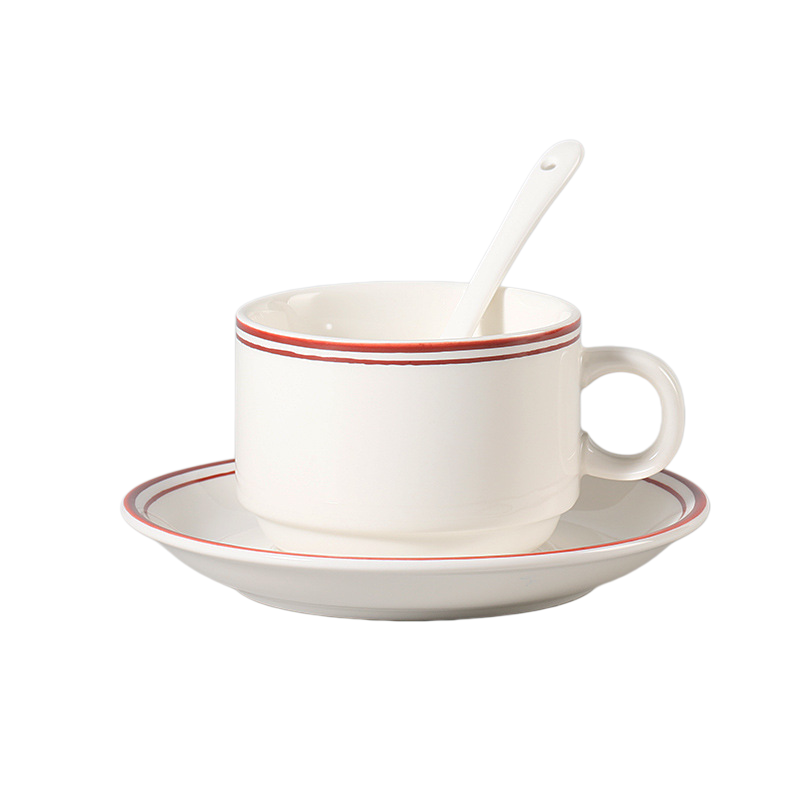
Products in this guide: Custom Coffee Cup and Saucer · White Stoneware Ceramic Salad Plates
Each of those failures is a process failure, not a factory failure — which is good news, because a process can be designed. This guide lays out the complete sourcing journey from the first brief to the delivery review, in eight stages, with the document that binds each stage and the breakdown most likely to occur there. It is written for importers, distributors, hotel and restaurant groups, and brand teams that buy ceramic tableware in volume from Chinese factories. It reflects official public frameworks as of September 2026, is operational guidance rather than legal advice, and deliberately quotes no specific rates, thresholds or fees.
The Eight Stages at a Glance
| Stage | What the buyer drives | What the supplier must deliver |
|---|---|---|
| 1. Brief and specification | A written spec: body, glaze, decoration, size, quantity, packaging, target timing | Confirmation that the spec is manufacturable, with honest questions |
| 2. Supplier screening | Documented capability checks, not price comparisons | Test reports, certifications, capacity evidence, real batch photos |
| 3. Quotation and negotiation | SKU-level quotes and a written negotiation record | Itemised pricing and a clear statement of what is included |
| 4. Sampling and approval | Sample review against the written spec | Approved samples with the glaze and decoration to be mass-produced |
| 5. Contract and order | Agreed terms: payment, delivery, change control, claims | A written order acknowledgement that matches the contract |
| 6. Production control | Checkpoints through the run, not a blind wait | Progress evidence and instant notification of any change |
| 7. Inspection and shipment | Inspection before loading and a verified document set | Inspection result and a shipment that matches the paperwork |
| 8. Receipt, review and reorder | A delivery review that feeds the next order | A post-delivery record that closes the loop |
Work down the table and each stage hands the next one a cleaner problem. Skip a stage to save a week and the week is usually recovered at a far higher cost somewhere downstream.
Stages 1-2: Turn an Idea into a Specified Product
The brief is where programmes are won or lost. A vague brief — "white mugs, around 300 ml, logo on the side" — invites a factory to make its own assumptions, and its assumptions will be cheaper than yours. Write the specification down before contacting any supplier, and make it answer five questions. Body and material: bone china, porcelain, stoneware or earthenware, and why. Surface: glaze finish, colour, and any decoration — decal, sublimation, deboss — with the placement described on the actual form of the piece. Size and capacity in millimetres and millilitres, because "around 300 ml" is not a spec. Quantity and packaging: the order size, the carton configuration, and the retail or food-service packaging expectation. And timing with a target price band, because a factory cannot quote intelligently against a blank page.
Supplier screening is where buyers make the most expensive mistake in the process: comparing price lists before comparing capability. A supplier who cannot show you a current test report for food-contact ceramic, cannot document its factory and its batch records, and cannot produce real photographs of large production runs is not a cheaper supplier, it is an unverified one. Screen on five files first: food-contact test coverage that matches what you intend to ship, the certifications your destination market expects, production capacity evidence for your order size, quality-control history with export customers, and clean communication in a language both sides share. Only then compare prices, and compare them on identical specifications.
Stages 3-4: Price, Samples and the Approval That Binds
Ask for SKU-level quotations, not a range price. Each line should state the unit price, what it includes — decoration, packaging, carton marking — the MOQ for that SKU, the production lead time, and what testing documentation accompanies the batch. A quote that cannot be broken into those parts cannot be compared. On negotiation, the most productive conversation is not about the lowest number but about the specification: which element of the piece drives the cost, and whether a change in body, size or decoration moves the number more than bargaining ever will. A separate guide in this series walks through how to read a ceramic quotation and where the real cost drivers sit.
The sample is the legal anchor of the whole programme. Approve it against the written spec, in writing, and say what you are approving: form, glaze, decoration, weight, finish. The approved sample defines the mass-production standard, so the factory must keep a reference sample of the approved version and mass production must be matched against it. Insist on change control from this point forward: no change to body, glaze, decal or firing without your prior written approval. Samples that arrive before the final approval exist to resolve open questions, not to replace the approval step.
Stages 5-6: Production and the Quality Conversation
Once the order is placed, production is not a waiting period, it is a series of checkpoints. The sensible buyer agrees with the factory, before production starts, what evidence will be sent and when: body and glaze confirmation from the first kiln, decoration approval on the first fired pieces, and photos or video of the packing line. The factory side of this relationship — how batch sizes, kiln loading and decoration runs set the MOQ and the schedule — is explained in a separate guide on minimum order quantities and production planning.
The quality conversation runs throughout, not at the end. Two questions carry most of the weight. First, is the mass production the same as the approved sample — same glaze batch, same decoration, same firing? Second, if anything differs, has the buyer been told before the difference is shipped rather than after? Most recoverable quality problems are recoverable only because someone was told early. Make early notification a contractual expectation, not a favour.
Stages 7-8: Inspection, Shipment and the Reorder Loop
Inspection belongs before loading, not after arrival. Agree the inspection standard in the order — the sampling approach, the critical and major defect criteria for food-contact and appearance, and whether a third-party inspection company is used — and run it against the approved sample. The mechanics of batch sampling and pre-shipment checks are covered in a separate guide on inspection and shipping in this series. The shipment itself must carry a document set that matches the goods exactly: commercial invoice, packing list, transport document, and the compliance file behind the SKUs — the declaration and current test report that the destination market expects.
Delivery is where the next order is designed. Hold a short review after the goods arrive and the first sales or service feedback comes back: what sold, what drew complaints, what the delivery taught you about specification, packaging or timing. That review feeds the reorder — and a programme that reorders well is built on the relationship patterns covered in a separate guide on long-term cooperation with a ceramic factory.
The Paper Trail That Runs Through Every Stage
| Document | Stage it serves | Why it matters |
|---|---|---|
| Written specification sheet | 1 | The reference every later document is checked against |
| Supplier capability file | 2 | Test reports, certifications and capacity evidence |
| SKU-level quotation and negotiation record | 3 | Prevents "that was not what we agreed" disputes |
| Sample approval, in writing | 4 | Defines the mass-production standard |
| Order acknowledgement | 5 | Confirms terms, quantities and dates in one place |
| Production progress evidence | 6 | Shows the run is on spec before it is too late |
| Inspection report and document set | 7 | Matches the batch as shipped to the file behind it |
| Delivery review notes | 8 | Feeds specification, packaging and timing decisions for reorders |
Common Breakdowns and How to Prevent Them
- Timing collapse. The schedule was planned in days while production and sea freight run in weeks. Fix it at the brief: agree a written schedule in weeks from order to door, and add margin before seasonal windows.
- Specification drift. Somebody changed the piece — a glaze, a size, a decal position — and the change travelled through production silently. Fix it with written change control and reference samples.
- Evidence gaps. The test report does not cover the decoration as shipped, or the invoice does not match the packing list. Fix it by making the document set part of the order, checked at inspection.
- Approval theatre. Samples are approved informally, by chat, and later disputed. Fix it by approving in writing against the spec, every time.
Your Process Checklist
- Written specification sheet exists before any supplier conversation.
- Supplier screened on capability files first, price compared only on identical specs.
- SKU-level quotation received, itemised and recorded.
- Sample approved in writing against the spec; reference sample kept by the factory.
- Change control agreed: no body, glaze, decal or firing change without prior approval.
- Order acknowledgement matches the contract terms and dates.
- Production evidence schedule agreed before production starts.
- Inspection standard and timing agreed in the order, run before loading.
- Shipment document set matches the batch exactly, including the compliance file.
- Delivery review held, feeding the reorder.
Run the process once and the first order is no longer a gamble, it is the first iteration of a system. The stages stay the same for every programme — coffee mugs, dinner plates, bowls, full tableware sets — and so does the discipline. Destination-market rules change over time, so the working reference for any compliance question is the latest official announcement from the relevant authorities; this guide reflects the official public framework as of September 2026. For custom OEM work, our factory-direct custom page walks through what a buyer prepares when the programme is built around a bespoke design.
"Start Your Ceramic Sourcing Programme"
Explore products featured in this guide:

Have questions? See our Sizes & Finishes FAQ and Ordering & Certifications FAQ.
Need a custom quote? Send an inquiry or browse our full product catalog.