
Printable Area on a Mug: How Much Room Your Design Really Has
A logo is approved on a flat artboard, sized to look generous, and comes back on a fired mug looking cramped and bent. Nothing was misprinted. The artwork was simply never given the space it was drawn for.
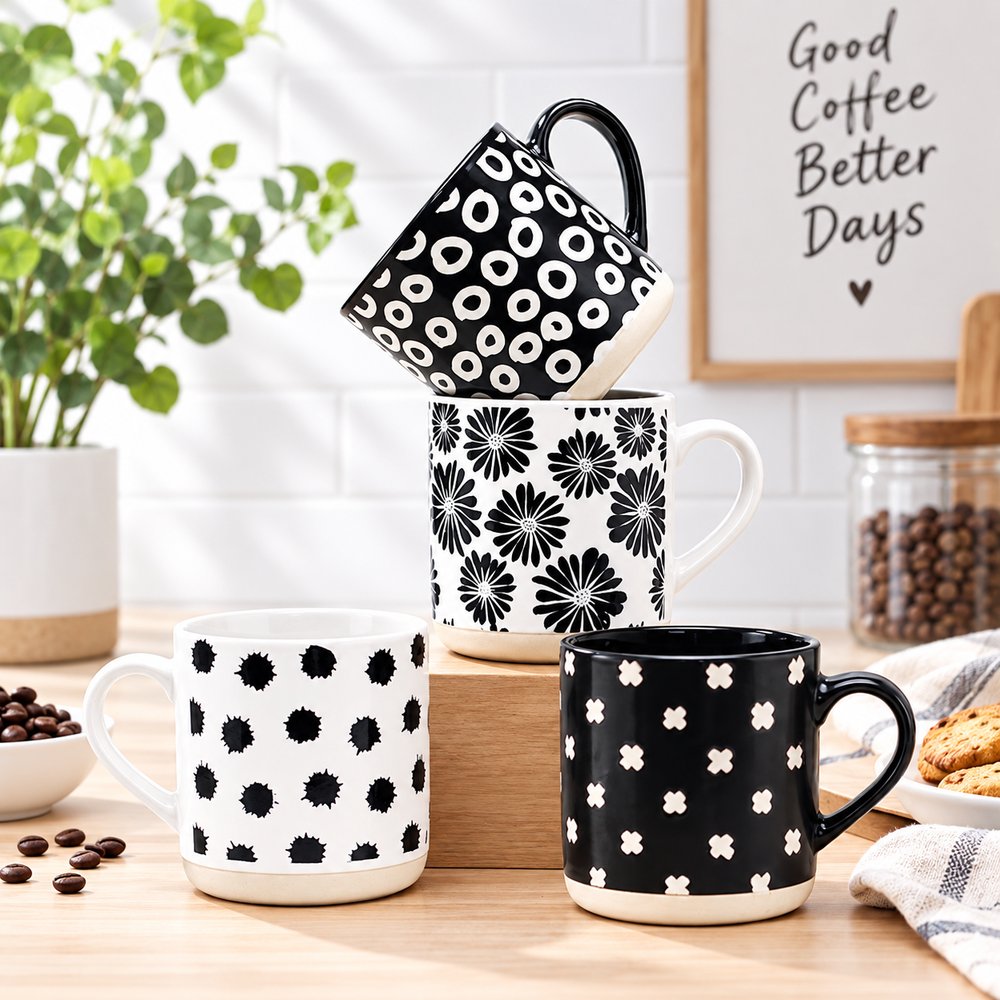
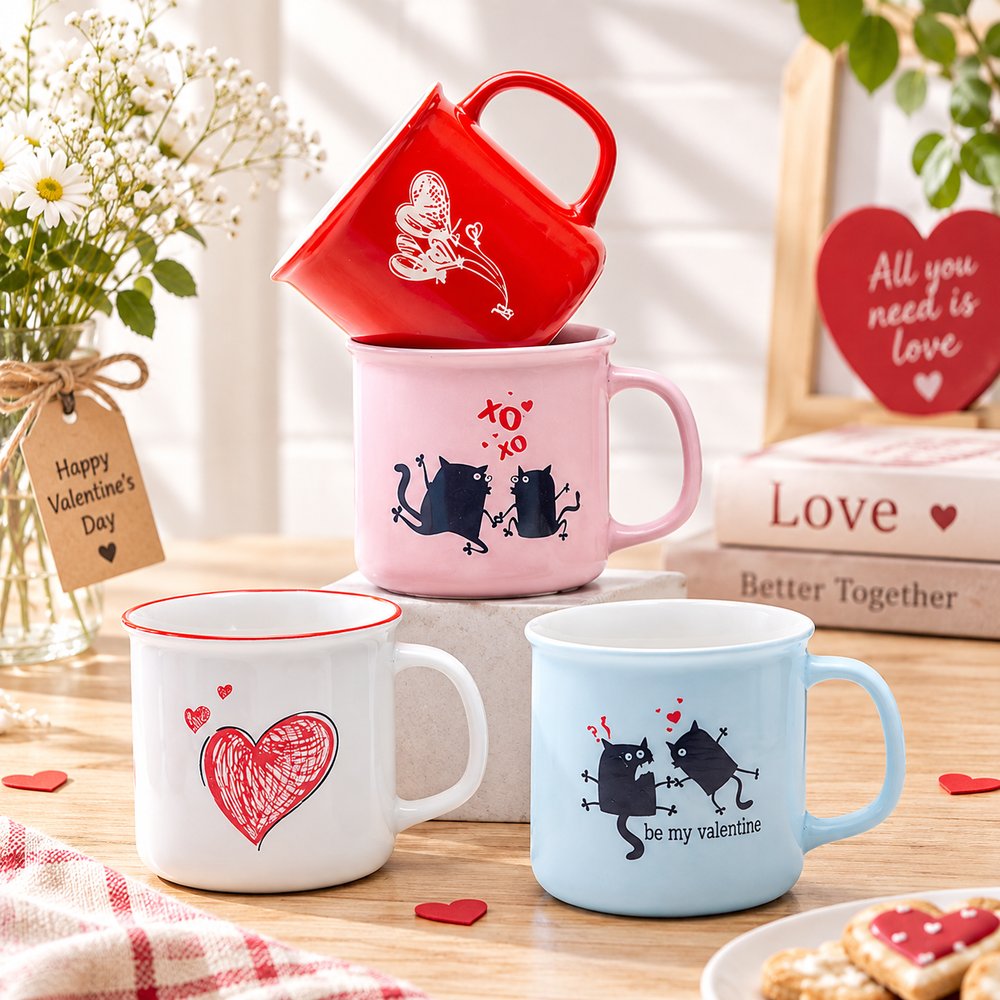
Products in this guide: Black and White Geometric Ceramic Mug 460ml · Love Message Ceramic Mug 396ml
A mug is not a page with a glaze on it. It is a cylinder with a handle on one side, a rim that curves away from the eye, and a foot ring that interrupts the bottom of the body. Each of those takes room away from the design, and the amount is knowable before a single decal is made.
Printable area is the part of this that buyers usually leave to the supplier. That works while the artwork is a small centred logo. It stops working once the design carries type, a strapline, a pattern that has to meet at a seam or a photograph, because then the question of how much room actually exists becomes a project decision rather than a production detail.
A flat drawing and a curved body disagree
The first number that matters is the circumference, and it comes from the diameter rather than from the drawing. A body measuring 80 mm across gives roughly 250 mm around it; a 90 mm body gives about 283 mm. That is arithmetic, not a factory claim, and it sets the ceiling on everything else.
The second number is how much of that circumference a design may occupy. A full wrap uses nearly all of it and needs a seam that either hides behind the handle or is designed as a deliberate break. A one-side print uses perhaps a third. A two-side print gives two windows and leaves a gap that the eye reads as a border whether one was planned or not.
Curvature finishes the job. Artwork laid onto a cylinder compresses towards the silhouette edges, so a circle drawn on paper prints as a narrow ellipse and a grid of even squares arrives with the outer columns squeezed. This is geometry, not error, and why a design balanced on screen can look crowded in the hand.
Three zones on every body
Read the surface as three bands, not one field.
- The live area, where decoration reads cleanly from the angle a person actually holds a mug, roughly between the upper third and the lower quarter of the body.
- The safe zone, which is the live area pulled in from every edge, and where type and critical marks have to sit so that curve and process tolerance cannot eat them.
- The dead zone, meaning the rim, the foot ring and the handle root, where decoration either cannot be applied or will not survive handling and washing.
Most decoration problems are not printing failures. They are type in the dead zone, or a key element on the boundary of the safe zone, where a millimetre decides whether it reads.
Where fine detail disappears
Two limits govern detail: how the decoration is applied, and how small a mark can be before the eye stops resolving it at arm's length.
Screen print holds a solid colour and struggles with fine gradients. A decal carries photographic detail and needs a minimum stroke width to survive transfer and firing. Laser engraving removes material, so it renders tone through line density, and very light tints break into visible dots.
The practical test is not the resolution in the file. It is whether the smallest element is still legible at the distance a customer holds the mug, roughly the length of a forearm. Anything meant to be read there needs a stroke wide enough to survive firing, and only a printed piece at final size confirms it.
The rim, the foot and the handle
Three places where designs break, and all three are predictable.
At the rim, decoration running to the edge is dragged by the curve and by the glaze, so a border meant to be straight arrives slightly wavy. At the foot, the ring interrupts the body and a pattern designed to sit low loses its bottom row. At the handle, the root covers surface that the layout assumed was available, so a wrap has to decide whether the seam hides behind it or repeats deliberately. The spec freeze guide explains how artwork and packing files are locked between orders.
A fourth is quieter: the fill line. A design sitting low can be hidden by dark liquid; one sitting high can be cut by the rim in a photograph though intact in the hand.
What to ask before artwork is released
Send the artwork at actual size on a flat layout of the body rather than as a standalone file, and ask for the printable dimensions of that specific article in millimetres. A supplier who answers with a drawing is working from a real specification. One who answers with a percentage is guessing.
Ask which zone the design occupies, whether any element sits inside the margin of the safe zone, and where the seam falls if the design wraps.
Then ask for one printed piece at final size before the run starts. A flat proof confirms colour and layout on paper, which is useful and not sufficient. Only the curved, fired object shows what the type looks like where the body turns away from you.
The wrap decision is the expensive one
One-side, two-side and full wrap are not variations on the same design. They are three different layout problems with different costs, and the choice is usually made late, after the artwork is approved, which is the worst moment.
A full wrap needs the pattern to close on itself, a seam that is either hidden or designed, and an acceptance that the busiest part of the design will sit on the curve. A one-side print is calmer and cheaper and gives up the back. A two-side print carries two messages, and each has to work alone because nobody sees them together.
Settling this at brief stage costs nothing. Settling it after the decals are printed costs the decals. The master sample guide explains how sealed references keep batches identical.
What the printable area really tells you
The printable area is not a restriction invented by the factory. It is the physical description of the object being bought, and it is fixed before the first sample is made. Designs that respect it look deliberate. Designs that ignore it look like artwork that was shrunk until it fit.
So ask for the dimensions, draw inside them, and hold the result at final size before anyone commits to a run. The mug will not change shape to accommodate the layout. The layout has to be drawn for the shape.
Related Products
Explore products featured in this guide:


Have questions? See our Sizes & Finishes FAQ and Ordering & Certifications FAQ.
Need a custom quote? Send an inquiry or browse our full product catalog.

