


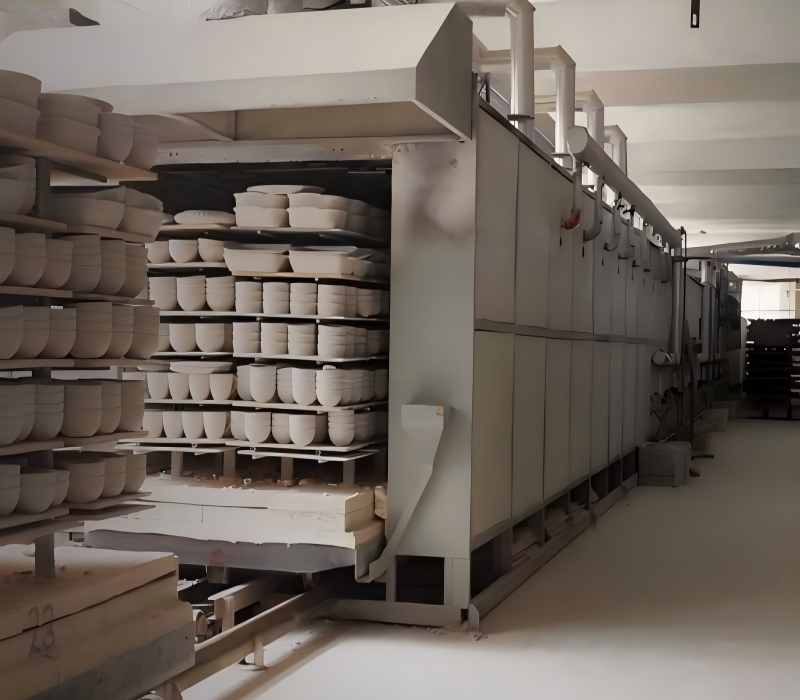



Piecework: What Your Order Looks Like When the Line Is Paid by the Piece
Ask a tableware factory how it pays the people who make your order and the answer is rarely a salary. It is a rate per piece: a fixed amount for every acceptable mug, bowl or plate that leaves a station. The rate varies by station and by shape, but the principle is universal.
Products in this guide: Large Ceramic Coffee Mug 650 ml · Espresso Cup And Saucer Set
That one arrangement explains a set of behaviours buyers keep meeting and rarely connect. Why forming moves faster in a good week. Why seam finishing is shallower on some shipments. Why a selection bench that was severe in spring is tolerant in autumn.
We see this from the factory side, and it is not a scandal. Piecework is how a plant turns a fixed quotation into a variable cost, and it is part of why a volume price exists. The useful question is not whether it is used, but where the rate touches the product. See the full ceramic sourcing process map.
Four Places the Rate Reaches the Product
Follow one order from clay to carton and the pay structure appears four times, each with its own signature.
- Forming. Paid per piece out of the mould, an operator gains by running the body wetter, which releases faster, and by pressing slightly thin. Both pass on the day; both cost wall strength later.
- Fettling. Paid per piece, seam scraping becomes a pass rather than a finish. A step at a handle junction that a slower bench would feather smooth stays as a line.
- Selection. Paid per accepted piece, a selector gains by passing doubtful ware; paid per defect found, the same person gains by rejecting it. One bench, two opposite incentives, set by a rule the buyer never sees.
- Packing. Paid per carton, the divider that takes four seconds to seat is the first thing to go.
Quantity Is Paid, Quality Is Not
The asymmetry is structural, not moral. A good piece earns money. A defective piece earns nothing, and usually costs the person who made it nothing either: the clay, the kiln slot and the scrap all belong to the plant. Rework is worse than scrap for the same reason, because rework is normally unpaid time.
Minutes spent checking earn nothing, and a doubtful piece is worth passing. A plant that wants a different result must change what the arithmetic counts.
Three Pay Structures and the One Bench That Brakes Them
Piecework is not one system. Three versions appear differently in a shipment, and the difference shows in the defect pattern rather than in a brochure.
Pure piece rate. Fastest cycle, loosest selection, most volatile in peak season. It holds a date and drifts on the surface.
Piece rate with a yield coefficient. The rate is multiplied by line yield at settlement, so the crew has a reason to catch its own defects. Behaviour improves toward concealment: a doubtful piece mixed into the good count is cheaper than one scrapped.
Hourly with a crew target. Slowest and most stable, and the version most likely to stop and ask. It costs more per piece, so it survives mainly where a recall is the real risk.
All of this is arrested at one station. Selection is the last place a piece can stop, and it works as a brake only under three conditions. The people selecting are not paid on the output of the line they check. They have a written defect standard with photographs and limits, not an instruction to use judgement. And they can hold a batch without asking a supervisor who is somewhere else. Where one of the three is missing, the bench becomes a formality that produces a signature. A sealed reference piece is what makes the second condition real, because a limit that lives in a conversation moves with the person holding it. The master sample guide explains how sealed references keep batches identical.
Why the Last Week of the Month Is Different
Piecework settles on a cycle, and cycles have edges. Where the rate steps up above a threshold, the final days of the period are worth more per piece than the first, and the push to cross that step lands in the same week as the shipment.
The result is a batch that runs faster, selects looser and packs with less care than the one before it, from a plant whose process did not change. Buyers who read reject data by week rather than by shipment find this first.
Four Questions That Work
One broad question produces a yes and little else. Four narrower ones produce information.
What is the selector paid on: a rate per accepted piece, a rate per defect found, or an hourly wage. What does a reworked piece count as at settlement. Can the plant send last month reject rate by line, as a trend. And in the peak weeks, which week is this order scheduled into.
None of this asks a supplier to disclose a cost structure. All four indicate where a shipment is likely to be weak.
Three Faults That Are Not Piecework
Attribution matters, because a buyer who blames the rate for everything will miss the batch that failed for another reason.
Clay that arrives dry, or aged differently, produces defects clustered by body batch rather than by shift. Kiln position produces defects that cluster by shelf height and repeat across orders sharing a firing. Mould wear produces defects that begin after a tool change and deepen over the following weeks.
The test is distribution. Piecework faults follow speed: they scatter across the line, concentrate before settlement, and move when the calendar moves. The other three cluster by an object, a height or a date.
What to Write in the Order
Three lines make the subject visible without asking for a payroll file. Final selection is carried out independently of the output rate of the line being checked, and the standard is the sealed reference. Reject rate is reported monthly by line, as a trend. Reworked pieces are not counted as accepted output and may be sampled.
The third line is the one suppliers resist, because it removes the cheapest option. A reworked piece counted as output is a piece that was never really inspected. The spec freeze guide explains how artwork and packing files are locked between orders.
None of this is expensive, and none of it asks a supplier to abandon the system that lets it quote volume. It asks for the two places where the arithmetic can be checked: the bench that selects, and the record that reports.
Our minimum is 5,000 pieces per item or per decoration, the volume at which a monthly reject trend becomes a signal rather than a small number. Buyers who raise the subject early argue less about defects once the container is open.
Related Products
Explore products featured in this guide:




Have questions? See our Sizes & Finishes FAQ and Ordering & Certifications FAQ.
Need a custom quote? Send an inquiry or browse our full product catalog.