
When a Number Means Two Things: Decimals, Dates and Units in a Ceramic Order
A ceramic order is a document made mostly of numbers. One mug carries a diameter, a height, a capacity, a wall thickness, a handle clearance, a weight and a tolerance on each of those. Forty numbers for one item is conservative.
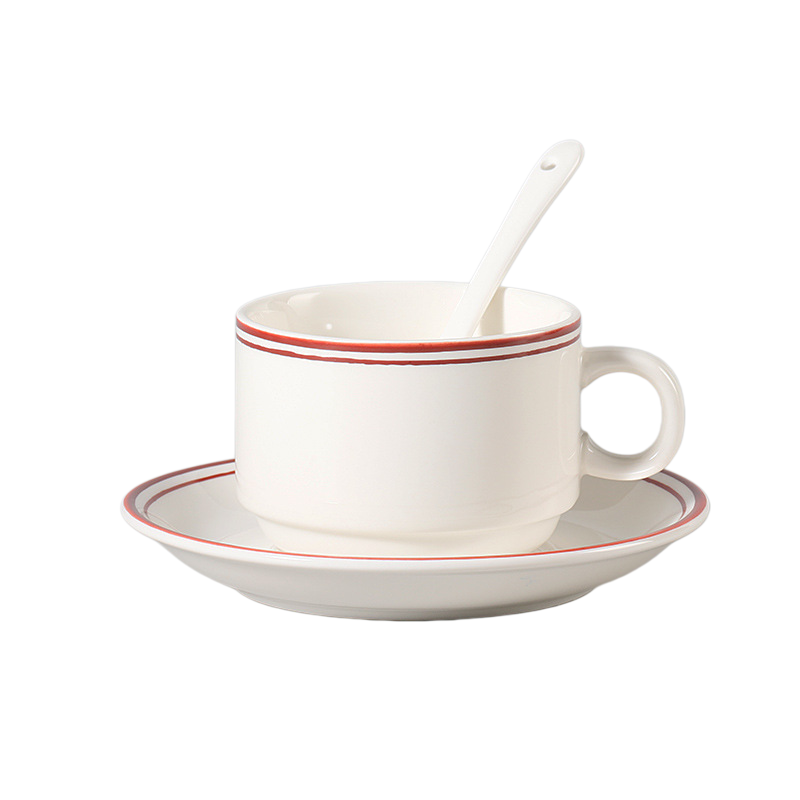
Products in this guide: Couple Illustration Ceramic Mug 318ml · Vintage Blue & White Porcelain Dinnerware Set
Each of them means something exact to the person who wrote it, and that is the problem. The writer is not the reader, and the reader will write the number down again in their own notation before anyone touches clay.
Three notations meet on one sheet: the buyer's market convention, the factory's workshop metric, and whatever the destination demands. A Spanish buyer, a Liling engineer and a German retailer can each be right about the same mug and still disagree about the line.
Three things stacked in one figure
A number is a value, a unit and a notation. The value is the quantity, the unit is what it is counted in, and the notation is how it is written down, which is the layer nobody negotiates.
Each reader converts what they see into their own convention, and restating is where a symbol changes without anyone deciding that it should. The error arrives at the mould rather than at the desk where it was made.
The comma that moves a value by a factor of ten
Most of Europe and Latin America write decimals with a comma. English-speaking markets and China write them with a point. Both are correct, and both appear in the same email thread every week.
A wall specified as 0,5 mm is half a millimetre in Madrid and five to a reader who takes the comma as a thousands separator. A thickness written as 1.500 mm is fifteen hundred millimetres under one convention and one and a half under the other. The characters are identical; the physical result differs by a factor of a thousand.
The separator builds the same trap from the other side. Five thousand pieces written with one is five thousand to a Spanish reader and five to an English one.
Two habits remove most of it. Write decimals with a leading zero, never a bare point, because a leading zero cannot be misread. And drop the separator in technical fields: 1500 mm, 5000 pieces, 1200 cartons. It carries no information a careful reader needs, and creates one ambiguity a careless reader will fall into.
The date that becomes another month
A date written as 03/04/2027 is two dates, the third of April in most of the world and the fourth of March in the United States. On a line that fixes an artwork deadline, that difference is a month of schedule.
Lead times are counted backwards from a ship date, so packaging ordered in the wrong week is a line that cannot pack, and an approval read a month late is a kiln slot lost.
Write dates year first, as 2027-04-03, or spell the month. Week numbers are worse, because week 12 is a different Monday depending on whose calendar is being counted.
Units that were never restated
The number is right, the unit is missing, and each side supplies the unit it works in.
- Drawings in inches, workshop in millimetres. An 8.5 inch diameter is 215.9 mm, and rounded to 216 mm it is no longer the approved piece.
- Capacity in millilitres and in fluid ounces, with the pack claiming one figure while the mould is built from the other, and neither saying whether it is capacity to the brim or usable fill.
- Weight in grams and in ounces, which sets carton board grade and freight calculation, so a fifteen per cent error is a carton that fails in transit.
- Pieces, sets and dozens. Five thousand sets of four pieces is twenty thousand pieces, and a line saying sets against a line saying pieces puts the order out by a factor of four.
- Tolerance in percentage and in absolute terms. Two per cent of an 80 mm diameter is 1.6 mm, which is not the same band as two millimetres, and only one of the two is inspectable.
None of this is a knowledge problem. Every buyer knows an inch is not a millimetre. The failure is that the unit lives in one document while the number lives in another.
Where the error actually lands
The cost of a wrong number is not the number. It is the stage at which it is found.
At the drawing, a correction is an email. At the sample, a round and a week. At the mould, a cavity, and a cavity is remade rather than edited. At the decal plate, a new plate and a re-approval. At the carton, a die and possibly the loading plan, because a carton twenty millimetres too tall changes how many fit in a container.
The earlier a number is restated in writing, the cheaper the correction, which is why the notation clause belongs at the head of the specification.
Five lines at the head of the specification
A notation clause is not legal language. It tells every reader how the numbers in this document are written.
- Dimensions in millimetres, one decimal place, decimal point, no thousands separator.
- Dates year first as 2027-04-03, or with the month spelled out.
- Quantities in pieces, with sets and inner pack counts written as a multiplication.
- Capacity as usable volume in millilitres, with the brim figure named separately.
- Tolerances in absolute units, with the measurement method named.
Five lines, and they survive translation, because they describe the writing rather than the product. The spec freeze guide explains how artwork and packing files are locked between orders.
Reading a document you did not write
Before a mould is cut or a packaging order placed, ask the factory to restate the three numbers that would hurt most if they were wrong, in writing.
The gap appears at once. A wall that comes back as 5 mm instead of 0,5 mm, a capacity in a different unit, a date shifted by a month. What this tests is not the factory's competence. It tests whether the document was readable by anyone other than its author.
The same applies to messages, where most small changes live: a number typed into a chat has no unit unless someone types one, and the next reader will supply their own.
The packaging guide explains how retail-ready and protective layers are specified together.
An order is rarely lost to a bad factory. It is lost to numbers that were correct in the office where they were written and had become something else by the time they reached the machine. A notation clause is the cheapest quality tool in the file.
Related Products
Explore products featured in this guide:



Have questions? See our Sizes & Finishes FAQ and Ordering & Certifications FAQ.
Need a custom quote? Send an inquiry or browse our full product catalog.

