



The Last Metre: Dust, Water Marks and the Cleaning Before the Box
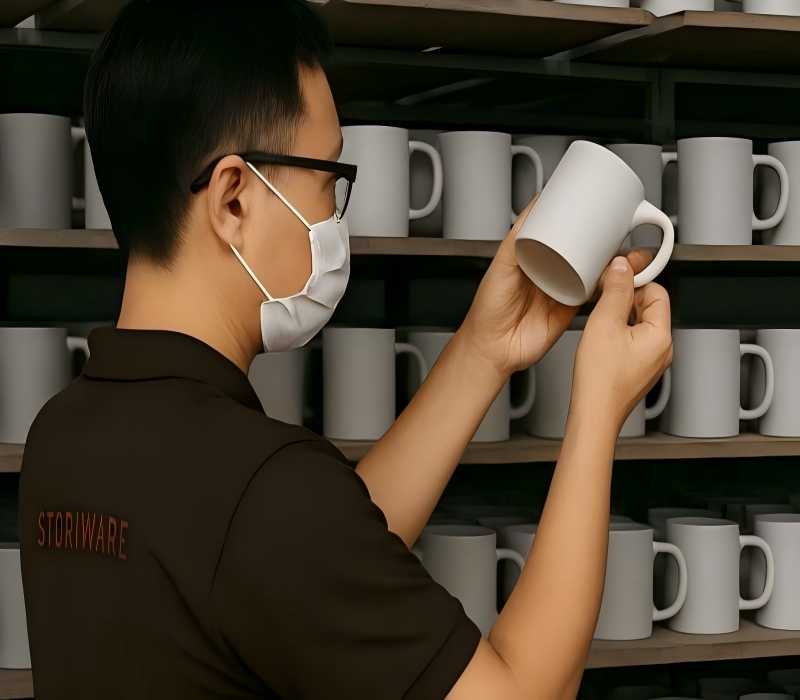
The mug has just passed. It was measured, tapped, turned over and looked at under the lamp, and it is good. Twenty minutes later it is inside an inner box, and the person who closed the lid never looked at the surface at all. Between those two moments sits the least specified step in the entire route.
Products in this guide: 500ml Stoneware Ceramic Mug Matte Glaze · Ceramic Soup Bowl Ribbed Design
No document in a normal order covers it. The specification describes body, glaze, decoration, dimensions and packing. The inspection plan says how many pieces to check and what counts as a failure. Neither says what the surface has to look like at the moment the carton closes, or whose name is on that condition when it turns out to be wrong.
What follows is a defect that behaves unlike anything else on the claim list. It is not a manufacturing fault, so the factory is right to say the piece left the line in specification. It is not transit damage, so the forwarder is right as well. It appears at the customer's goods-in, gets photographed, and becomes a claim nobody can assign, because the condition was never written down.
Dust is a dwell time, not a level
The instinct is to blame the plant. Ceramic factories are dusty places, so dust on the product looks inevitable. That is the wrong variable. Two pieces from the same kiln can leave with completely different surfaces depending on where they waited.
A piece that moves straight from the unloading bench into closed storage picks up almost nothing. A piece that stands on an open rack in the packing hall for two days collects a film, and the film lands on the inside of the cup as well, where nobody looks until a customer pours. The number worth controlling is not the dust in the air. It is how long the ware spends uncovered, and in which part of the building.
Four marks, four different causes
Most surface complaints arrive described the same way — the mug was dirty — and they are not one problem.
- Kiln dust. A dry, even film, heaviest on the top layer of a setting and on every upward face. It wipes off easily, and it is the only one that does.
- Water marks. Produced by cleaning. Plant water carries minerals, and a damp cloth leaves a ring that dries into the glaze. It reads as a stain on dark and mid-tone bodies while staying invisible on white.
- Fingerprints. Skin oil on a matte or satin glaze does not evaporate. A print made in the morning is still there at packing, and after a warm day it is part of the surface.
- Handling scuffs. Two pieces rubbed together, or a piece dragged across a bench. On glaze it is a grey line that will not wipe off. On gold or platinum it removes the decoration outright.
The wipe that creates the fault
Cleaning at the end of a line is usually improvised, and the improvisation is where the second defect is born. A cloth is used until it is visibly dirty, which means it is moving dust from piece to piece rather than taking it away. A damp cloth is used because dry wiping takes longer, which introduces water marks and, on an unglazed foot, drives moisture into a ring the kiln spent hours drying. A solvent goes on a stubborn mark and takes the surface with it. An abrasive pad goes on a scuff that turns out to sit under the glaze, so a mark that could have been argued about becomes a scratch that cannot.
A workable rule fits in one sentence. Dry, lint-free, one direction, and if a mark needs anything stronger than a dry cloth it is not a mark. It is a defect, and it belongs in the report rather than on the bench.
Why the last inspection cannot see it
Inspection lighting is set to reveal what inspection is looking for: glaze faults, colour drift, decoration registration, chips at the rim. That light is diffuse and frontal, and a thin film is close to invisible under it. The same film is obvious under raking light, from a low angle, at the customer's own bench.
The second reason is structural. Inspection happens before packing, on a sample of pieces, at a station that is not the packing table. The surface condition at the moment of boxing is therefore never examined, by design rather than by neglect. Putting a cleaner on the packing line does not change that. Only a defined check after the wipe does.
The box is part of the surface
A clean mug in a dusty inner box arrives dirty, and the dust in the box is generated by the box itself. Corrugated flutes shed, moulded pulp sheds more, and recycled board releases a fine fibre that settles on glaze across a long sea freight. This is why the protection layer and the presentation layer have to be specified together instead of chosen at the end. The packaging guide explains how retail-ready and protective layers are specified together.
Four lines that turn it into a specification
The gap closes with four statements, and none of them is expensive.
- Position. A clean-and-check point after final inspection and before the inner box closes, written into the route with a time allowance. A step with no allowance is a step that disappears the week the order runs late.
- Method. Dry lint-free wipe, no water, no solvent, no abrasive, brush only on the unglazed foot. A short list of prohibited actions is easier to enforce than a description of clean.
- Reference. One piece agreed as the minimum acceptable surface, sealed, labelled and kept beside the master sample. The master sample guide explains how sealed references keep batches identical.
- Verification. Who checks, how often, under which light, and where the result is written. A finding with no line in a record is a finding that will come back.
The pass nobody is measured on
The person wiping the last piece is usually the most junior on the line and is measured on cartons per hour. The order of priorities is therefore predictable: when a shipment is late, the wipe is the first thing dropped, and a late shipment is exactly when the ware has been standing on the racks longest. Writing the step into the route changes who answers for it without changing who does it.
Cleanliness behaves like every other requirement on an order. Written down, it has a method, a reference and a signature. Left unwritten, it defaults to looks fine from a metre, and the first person to apply a stricter standard is the customer, holding the mug under a light of their own.
Related Products
Explore products featured in this guide:


Have questions? See our Sizes & Finishes FAQ and Ordering & Certifications FAQ.
Need a custom quote? Send an inquiry or browse our full product catalog.