





The Floor Between Two Stations: Where Ceramic Work in Progress Waits
There is a stretch of ground on a plant floor that belongs to no department: the space a piece occupies between the machine that made it and the station that will finish it. A tray left on the floor, a board on a trolley, four crates pushed against a wall. The piece is finished at both ends of that journey and owned at neither.
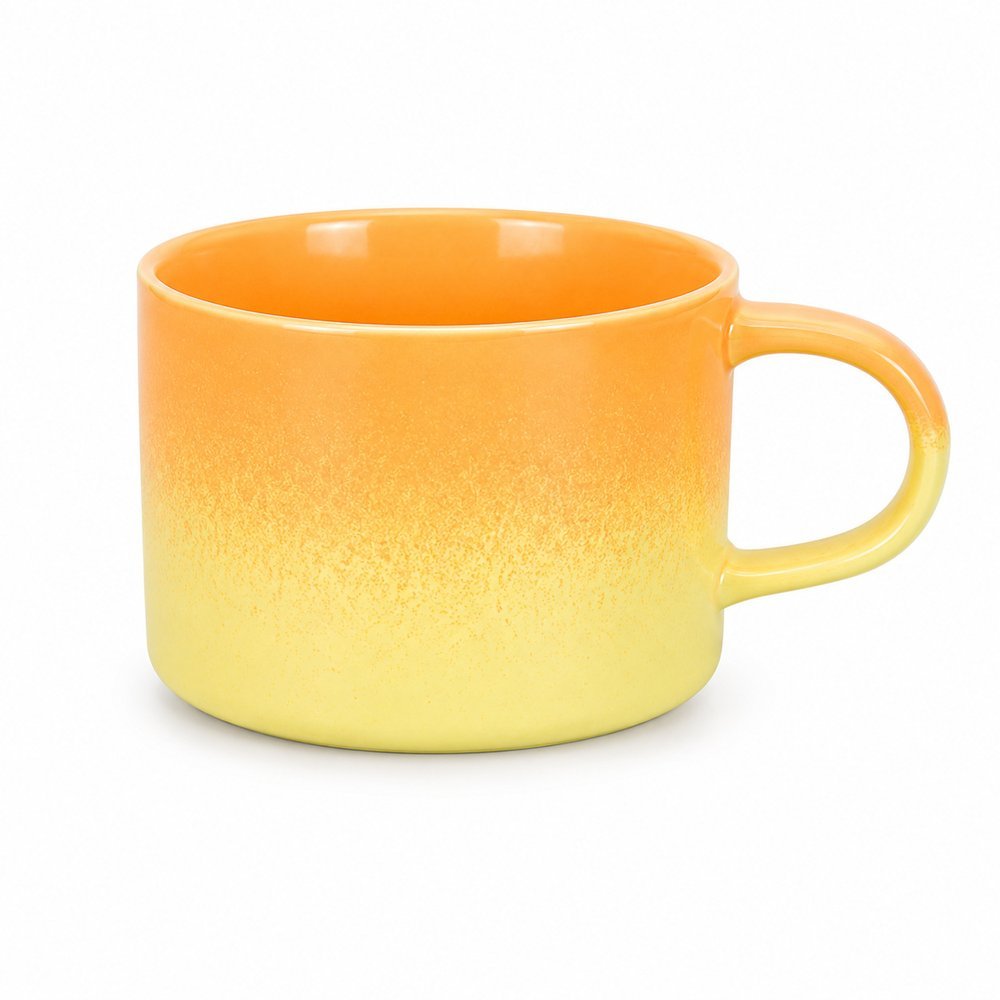
Products in this guide: Matte Speckled Gradient Ceramic Mug 380ml · Ceramic Soup Bowl
Buyers audit gates. Incoming material, greenware, bisque, glaze, packing. Each of those gates has a document attached to it. The distance between them has none, and it is where much of the chipping, the mix-ups and the missing pieces is created. No inspection report asks where a piece was standing when it broke.
We supply importers, chains and distributors who order from factories that run this way, and the pattern repeats: the specification defines the piece, not the route it travels to get made. Here is what happens in that gap, and the four rules a buyer can write down to close it. See the full ceramic sourcing process map.
The Waiting State Belongs to Nobody
A station has a person accountable for what leaves it. Between stations the piece is in transit, and in transit it belongs to whoever is closest. This is not negligence: work is counted where it is produced, so accountability stops at the station door.
The consequence is a gap in three systems at once. No fixed location, so no place to look. No count, so a shortfall only appears at the end of the run. No owner, so damage found later is attributed to the station that received it, not the one that sent it.
That last point is the expensive one.
Four States, Four Different Ways to Fail
A piece waiting on the floor is not one thing. The state it is in decides what the wait does to it, and a single handling rule cannot serve all four.
- Wet and leather-hard. Still carrying water, soft enough to deform under its own weight. Support matters more than protection: a slow sag on a soft board becomes a base that no later process can flatten.
- Dry greenware. Strong enough to lift, brittle enough to chip at the rim. Most handling marks are made here, because the piece is touched by hand more often at this stage than at any other.
- Bisque. Fired once, porous, mechanically tougher. It survives handling but takes contamination: dust, oil from a hand, a mark that will read through the glaze.
- Glazed and unfired. The most exposed condition in the plant. The glaze is powder held by adhesion, so any contact leaves a rub that cannot be repaired without stripping the piece and starting again.
The same trolley and the same habit produce four different results. A plant that treats waiting as one condition is wrong at all four.
What Decides Whether a Piece Survives the Wait
Three physical things do most of the work, and none appear in a quotation.
Support. A piece needs a flat surface under its full base. Trays that sag, boards that flex and ware balanced on a pallet corner all end the same way: a base that is no longer flat when it reaches the kiln.
Stacking. A rim is the strongest part of a fired piece and the weakest part of a green one. Ware stacked rim to rim before firing puts load exactly where the material is thinnest, and the crack that opens in the kiln started on the shelf.
Contact. Two pieces touching is a scratch in waiting, and a glazed surface is the least forgiving. Felt, foam or paper between layers is a cost that is almost never costed.
The Mix-Up Nobody Counts
Damage is the visible cost. The invisible one is identity.
Two orders can share a corner for an afternoon. If neither tray carries the order, the item and the stage, the two merge. The counts separate at packing, the buyer receives a mixed carton, and the factory spends a week reconstructing which piece belonged to whom. The usual defence is a sealed reference kept at the station, so an unlabelled piece can be identified by comparison. The master sample guide explains how sealed references keep batches identical.
A quieter version: a piece is put back on the wrong trolley and delivered to the wrong station. It is made, fired and packed, entirely correct, except that it belongs to a different order.
Why the Inspection Report Cannot See It
Inspection is organised by gate. A piece is checked when it arrives at greenware, at bisque, at glaze and at packing, and each records what it looks like at that moment.
A chip found at the glaze gate is therefore recorded at the glaze gate. The report is accurate and the location is wrong. Multiply that across a run and the defect Pareto points at the station where damage was discovered, never at the floor where it happened, so the corrective action lands in the wrong place.
Four Rules Worth Putting in Writing
None needs a new process. Each needs a decision written down rather than assumed.
- A named place. Every stage needs a defined holding area, marked and sized, so that in-transit ware has an address instead of a habit.
- A maximum wait, on a label. Every tray carries the order, the item and the date it was filled. A tray that has sat beyond the agreed limit is re-inspected before it moves on.
- A stacking rule. How many pieces per layer, what goes between them, and whether rims are ever allowed to carry load.
- A count at handover. Pieces leaving a station equal pieces arriving at the next one, or the difference is explained while both teams are still standing there.
The last rule is the only one that produces a number, and the one that changes behaviour. A discrepancy named the same day is a handling question. Named three weeks later at packing, it is a mystery charged to whoever holds the carton.
What to Ask on the Walk
Ask to walk the route a piece takes from forming to glaze, not the one a visitor is shown. Ask what a trolley holds and who moves it. Ask where a tray goes when the next station is not ready for it. Those answers describe a plant better than any capacity figure.
Our minimum is 5,000 pieces per item or per decoration. That figure is a production quantity, and production quantities are made of pieces that have to survive being moved between machines. The drawing defines the piece. The floor decides how many reach the container.
Related Products
Explore products featured in this guide:


Have questions? See our Sizes & Finishes FAQ and Ordering & Certifications FAQ.
Need a custom quote? Send an inquiry or browse our full product catalog.