




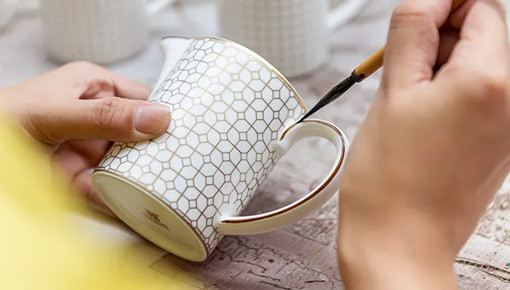

The Cold Half: What Freezing Does to a Ceramic Mug
A mug earns its approval at the kettle. Boiling water goes in, the wall takes the gradient, the glaze either holds or crazes, and the buyer signs the piece off. Nobody puts the approved sample in a freezer, and nobody asks what happens when it comes back out.
Products in this guide: New Bone China Ceramic Mug · Ceramic Soup Bowl Ribbed
Cold is treated as the absence of heat, which would make it a milder version of the same test. It is not. Heat drives stress outward from a surface that expands first. Freezing works from inside the wall, where water has been sitting since the piece was dipped, and the expansion is volumetric: water occupies about nine per cent more volume as ice than as liquid, and inside a fired body it has nowhere to go.
That difference decides when the failure appears. A thermal crack usually shows up in the factory or at first use, where somebody can still act on it. Frost damage often arrives weeks later, in a warehouse in a cold market, on goods that have already changed hands twice.
The Stress That Runs the Other Way
Heat and cold pull a ceramic wall from opposite faces. Pour hot water into a cold mug and the inner surface wants to expand before the bulk of the wall does, while the glaze moves at its own rate. Cool the same mug toward freezing and the movement reverses, but it is smaller, and on its own it rarely breaks anything sound.
What cold adds is water. A fired body is not solid. It carries open pores, connected channels that reach the surface, and those channels take up liquid every time the piece is washed, soaked or used. A dishwasher puts water in warm and takes it out warm. A freezer puts it in, stops it moving, and turns it to ice inside the wall.
Where the Water Sits
The number that predicts this is water absorption, measured on a fired piece from the batch in front of you rather than on a body data sheet. A vitrified porcelain absorbs very little, a stoneware absorbs more, and an earthenware body can hold several times as much again. The lower the figure, the less water is available to freeze, and the smaller the internal pressure when it does.
Two qualifications keep that from becoming a simple rule. Absorption is measured on a piece whose glaze is intact, and the unglazed foot ring, any pinhole and any crazed panel are open doors; a dense body behind a glaze that has begun to craze is a worse freezer candidate than a slightly more porous body with a sound surface. And absorption is a batch property. A change of clay source, a firing curve adjustment or a difference in kiln position can move it, quietly, between one run and the next.
Three Ways Cold Breaks an Order
The failure modes are distinct, and each one is handled by a different part of the file:
- Glaze spalling. Water enters the wall, freezes, and lifts the glaze away from the body in flakes or sheets. It starts at rims, edges and the foot, where the section is thin and the glaze is thin with it.
- Delayed cracking. The piece survives the freeze and fails on the next hot wash, or in the customer's hand. Nothing in the inspection record predicted it, because the stress arrived after the inspection.
- Cold shock. A piece taken straight from a freezer into hot water, an oven or a wash cycle crosses the same gradient as the boiling-water test, in reverse and at speed. The size of the temperature step matters more than either temperature on its own.
There is a fourth failure that has nothing to do with the ceramic, and it costs more per incident than the other three.
The Cold That Never Touches the Mug
A container moving inland through a northern winter can sit below freezing for days. The mug is fine. The packaging around it is not. Foam inserts stiffen as they cool and stop absorbing the energy they were chosen for. Corrugated board that picked up moisture in a humid plant turns brittle when that moisture freezes, and the glue lines let go before the board does. Tape loses tack. A carton that passed a drop test on a factory floor at twenty degrees is a different object at minus fifteen.
Then the load moves into a heated warehouse and the ice becomes water again, on the ware, on the board and inside the case. Ware that has been frozen wet and thawed damp carries the smell of the carton it travelled in, which becomes a separate complaint with the same root.
The packaging guide explains how retail-ready and protective layers are specified together.
What to Put in the Order
Cold is specifiable, and the specification is short:
- A water absorption figure with a ceiling and a test method, read from the batch rather than from the catalogue.
- The service conditions the figure has to cover: freezer storage, chilled display, outdoor winter use, or none of these.
- A cold cycle inside the approval protocol, with a stated low temperature, a stated dwell and a stated return to room temperature, run on the piece that becomes the sealed reference.
- Packaging verified at low temperature as well as at ambient, with the drop height and the test temperature written down.
- A storage clause: unheated warehouse, heated warehouse, or container only.
The master sample guide explains how sealed references keep batches identical.
The Questions That Cost Nothing
Most plants answer the absorption question within a day, because the test is routine. What they cannot answer quickly is whether the piece has been sold into a freezer before, and that is the question worth asking: has this body, with this glaze, on this shape and at this thickness, been through a cold cycle?
A buyer who asks it in the enquiry gets one of three replies, and all three are useful. Yes, with a report. No, but it can be run. Or a change of subject, which is an answer in itself.
The kettle test covers one half of a specification, and it is the half that is easy to run because the failure is immediate and visible. The other half is quieter. A mug that survives boiling water has proved it can take a gradient from one direction. Whether it survives a winter is a separate question, asked later, usually by somebody who was not in the room when the order was written.
Related Products
Explore products featured in this guide:


Have questions? See our Sizes & Finishes FAQ and Ordering & Certifications FAQ.
Need a custom quote? Send an inquiry or browse our full product catalog.

