
The Antibacterial Claim: What a Glaze Can Prove and What It Cannot
A hotel group issues a tableware specification, and one line sits in the glaze section: antibacterial finish required, evidence to be provided. Nobody on the buying team wrote it. It came from a brand standard or last year's tender for a different material. The factory answers within a day with a test report naming two strains, and the line is closed.
Products in this guide: Bone China Rice Bowl Set · Custom Ceramic Dinnerware Salad Plate
The report is probably genuine. That is the difficulty. A surface test measures something real, on a defined sample, and the distance between what it measures and what the sentence means in a tender is where the liability sits for the next three years.
What follows is what the word describes on a fired glaze, what a laboratory can put on paper, the four fields a report has to name, and the three numbers that do more for a hygiene clause than the adjective.
Where the Sentence Comes From
The request rarely starts with a microbiologist. It starts with a brand standard written for another material, or a tender template borrowed from a healthcare project. By the time it reaches a ceramic order it has lost its original scope and kept all of its confidence.
A surface claim written for a laminate counter carries a method, a contact time and a definition of what counts as a reduction. Compressed into one adjective in a tableware table, all three vanish. The supplier is then asked to satisfy a sentence that no longer contains the thing that made it measurable.
What a Fired Glaze Actually Does
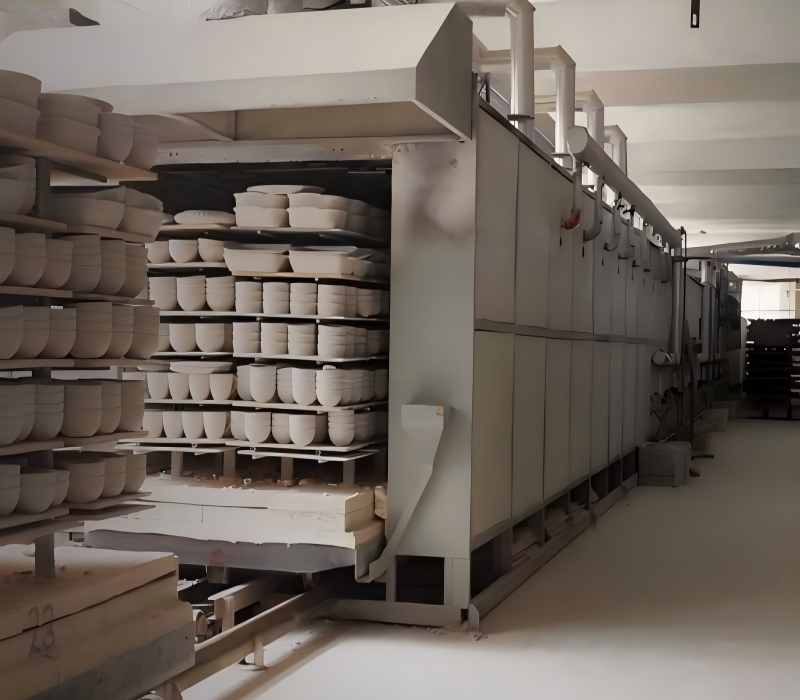
A glaze is a glass layer fused onto the body at high temperature. Its useful property after firing is not that it kills anything. It is that it closes the surface.
A vitrified body absorbs very little water, and the porcelain class is conventionally defined at half a percent absorption or below. A sound glaze on top of that gives residue nowhere to sit and releases soil in the wash. That is a real advantage, and it is not a claim.
Additives shift the picture slightly. Silver-ion compounds can be formulated into a glaze, and a treated surface can show a measured reduction under laboratory conditions. The effect is local, depends on contact and moisture, and says nothing about the piece in a dish rack at two in the morning.
The Test, and the Part It Leaves Out
The method usually quoted for hard surfaces is JIS Z 2801 and its international counterpart ISO 22196. Both were written for plastics and other non-porous surfaces. A glaze can be assessed on the same logic, but the report should say so.
The measurement is a comparison: a defined inoculum on the treated surface, the same on an untreated control, a set contact period usually around a day, and a comparison of survivors. The result is a logarithmic reduction, where two logs is ninety-nine parts in a hundred and three is nine hundred and ninety-nine in a thousand.
None of that is dishonest. It is narrower than the sentence it ends up supporting.
Four Fields the Report Has to Name
Most arguments about this claim are settled by reading the document, not by debating the glaze.
- The organism. Usually one Gram-negative and one Gram-positive strain, commonly Escherichia coli and Staphylococcus aureus. A reduction against two laboratory strains is not a general property.
- The surface. A glazed tile, a flat coupon and a whole piece are three samples. Rim, foot ring and unglazed areas behave differently, and the piece you sell is not the coupon that was tested.
- Contact time. Twenty-four hours of undisturbed contact describes a surface left alone, not a cup filled, rinsed and stacked four times an hour.
- Sample age. A freshly fired coupon and a piece that has been through a commercial wash line a hundred times are not the same surface. If preconditioning is not stated, assume there was none.
Two more fields deserve a glance: whether the laboratory holds ISO/IEC 17025 accreditation for that method, and whether the report covers the glaze you are buying rather than a sister product.
Where Hygiene Is Actually Decided
In service, microbial load is decided by things with no connection to an additive.
- The wash temperature and detergent concentration the machine was designed for.
- Drying and storage where air moves, rather than wet stacking in a closed cupboard.
- Glaze integrity. A crazed or chipped surface holds residue in a way a sound one does not, and this is the failure that turns a hygiene programme into a complaint.
- Water absorption, which predicts staining, crazing and a shorter dishwasher life, and is measured on the body rather than the glaze.
- Whether the piece does the job it was bought for. A mug holding utensils is not cleaned on the same rhythm as one holding coffee.
The Numbers Worth Writing Instead
If the clause exists to protect guests, three specifications do more work than an adjective.
- Water absorption, as a maximum tied to the body class being bought. It is checkable on every batch.
- Glaze integrity, as resistance to crazing after thermal cycling, plus a visible-defect standard for cracks that reach the body.
- Wash cycles, as a count of commercial cycles the glaze and decoration must survive, with test conditions named beside the number.
A supplier can answer all three from existing batch records.
When the Claim Cannot Be Removed
Sometimes the sentence is immovable, because it sits in a group purchasing contract or a public tender. Then the work is to make it specific rather than to argue.
Rewrite the line so it names the method, the organism, the contact time and the surface, and attach the report as an appendix rather than a footnote. Restrict the wording to the tested surface, because a claim about a coupon is not a claim about a rim.
Keep the claim off the piece and off the carton unless the evidence covers exactly what is printed. Consumer-protection rules in the European Union and the United States put the burden of proof on the business making the statement, and a glaze additive is not a licence to print a word. The spec freeze guide explains how artwork and packing files are locked between orders.
A glaze can be dense, smooth and easy to clean, and those are properties a buyer can verify on arrival. Whether it reduces bacteria on a surface nobody washed is a different question, and the answer usually belongs to the dish room rather than the kiln.
Related Products
Explore products featured in this guide:


Have questions? See our Sizes & Finishes FAQ and Ordering & Certifications FAQ.
Need a custom quote? Send an inquiry or browse our full product catalog.