





Sales Said Yes: The Order Review Between Your PO and a Production Slot
A purchase order goes out on Monday. By Tuesday afternoon the reply is back, warm and short: confirmed, no problem, we will arrange production. The buyer stops chasing, tells the retail team the container lands in week 42, and books the promotion.
Products in this guide: Printed Stoneware Ceramic Mug · Porcelain Ceramic Soup Bowl
Three weeks later the date moves. Not because anyone lied. The salesperson answered a question about willingness, and the buyer heard an answer about capacity. Between those two sentences sits a step most buyers never see: the order review, the internal gate where a plant decides whether it can accept the work it has just been sold.
That gate is where a date is created. To build a schedule you can rely on, you need to know what it checks and which of its three answers you received.
Two yeses, and only one is a commitment
The first yes comes from sales, made against what the factory has done before: this shape, this glaze family, this decoration method, this kind of carton. Reasonable, and not a schedule.
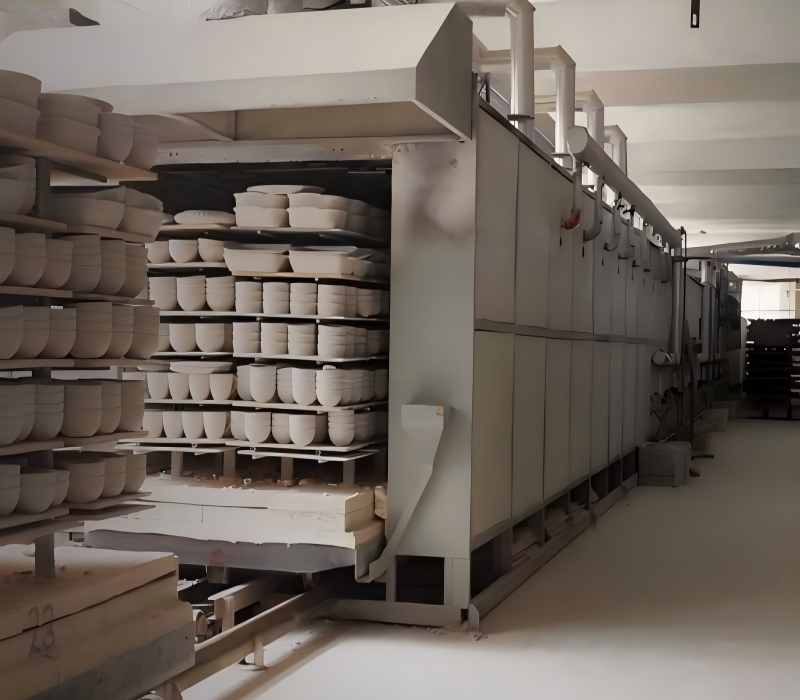
The second yes comes from the plant, against objects that exist in a specific week: a mould at a stage of its life, a glaze batch mixed to the approved colour, a screen or decal in stock, a kiln setting with room, a packing line with hands. The first is capability. The second is capacity, and different people hold the two answers.
In a small factory one person may give both within an hour. That is convenient and slightly dangerous: the capable answer is ready faster, so it is the one that gets typed.
What the review looks at
Four checks run in most plants, and any of them can end the review.
- Tooling. Whether a mould for this body exists, in whose name, and how much of its life is left. A new shape needs a master model, working moulds and a trial before any date is real.
- The decoration route. Screen, decal or direct print; in-house or bought in; and whether kiln space for decoration firing exists in the same week as the glost firing.
- Materials. Body and glaze are usually stocked. What fails a review are items with a lead time of their own: a specific carton, a custom insert, a lid, a new colour reference.
- The calendar. Not capacity in general, but whether this order fits behind the orders already accepted for that week. Buyers underestimate this one: it depends on other people's orders and changes fastest.
A factory that answers in two hours has usually done the first two checks and skipped the last two.
The three answers a review can give
A clean yes means all four checks passed on the information available. It is the only answer that carries a date the plant intends to keep.
A conditional yes means the order is accepted with assumptions attached: the colour will be matched when the lab dip is ready, the insert confirmed once the structural sample is approved, the carton will arrive because a supplier promised it. The plant is not lying. It is scheduling work whose prerequisites are still open.
A no is the least common and the most useful. It usually arrives as a softer sentence, a longer lead time, or a request to move the quantity.
Why the conditional yes is the expensive one
A conditional acceptance moves the decision onto the shop floor, where nobody has the authority to wait. The line is set, the operator holds a work order, and the artwork is not final. The gap gets filled by whoever is closest: a colour that is nearly right, a carton that almost fits, a print position judged by eye.
That is why failures appearing later rarely look like a review problem. They look like a colour two steps off, an insert that does not hold the piece, a carton that arrives after the goods. Each was a condition closed by default instead of by decision.
The lever is not to refuse conditional acceptance, but to make the conditions explicit, dated and owned.
What a buyer can send that shortens the review
The review is only as good as the file in front of it. Five lines do most of the work: what the piece is, with fired dimensions rather than drawing dimensions; the decoration reference, as method and colour standard; the quantity per design, separately, because a mixed order is reviewed per design and not as a total; the packing spec, down to carton and insert; and the date the goods must be at destination, not the date they leave the factory.
A factory given a ship date schedules backwards from the container; a factory given an arrival date has to show where the inland leg and the sailing fit, which is an earlier and more honest conversation.
A physical reference still beats a description. Where colour or surface is critical, a sealed sample in the plant's hands removes an argument the review would otherwise schedule around. The master sample guide explains how sealed references keep batches identical.
Three things to ask for afterwards
You cannot attend the review, but you can require its output.
First, a written acknowledgement stating the production start week and the ship window as separate dates. If it only repeats the date you requested, nothing was reviewed.
Second, the conditions list: what is open, who closes it, and by when. A conditional acceptance without that list is a promise that the plant will guess.
Third, the name of the person who approved it. A commitment with a person attached behaves differently from one attached to a mailbox.
Ask for the same three on a repeat order, and if the answer is last time's document with a new date, ask what changed. Price validity belongs in that check: a schedule built on an expired quotation is waiting to be renegotiated. The quote validity guide explains how to hold prices on long programs.
The second order clears faster, until something resets it
Repeat orders move quickly for real reasons: the mould exists, the artwork is already separated into screens or plates, the carton has a die, the colour has an approved reference. The review becomes a calendar check.
Four things send it back to the start: new artwork, even on the same body; a new carton or insert; a colour that must be matched again because the reference has aged; a mould past the point where its output still matches the sealed sample. Each looks like a small change to the buyer and a new article to the plant.
The gap between a reply and a commitment is usually one week wide. Closing it early costs a conversation; discovering it in week 42 costs a season.
Related Products
Explore products featured in this guide:




Have questions? See our Sizes & Finishes FAQ and Ordering & Certifications FAQ.
Need a custom quote? Send an inquiry or browse our full product catalog.