






Green Strength: Why the Crack Starts Before the Kiln
A mug that cracks in the kiln is rarely telling the truth about when it broke. It was formed, dried, trimmed, handled and loaded first, which is five chances to start something heat only makes visible.
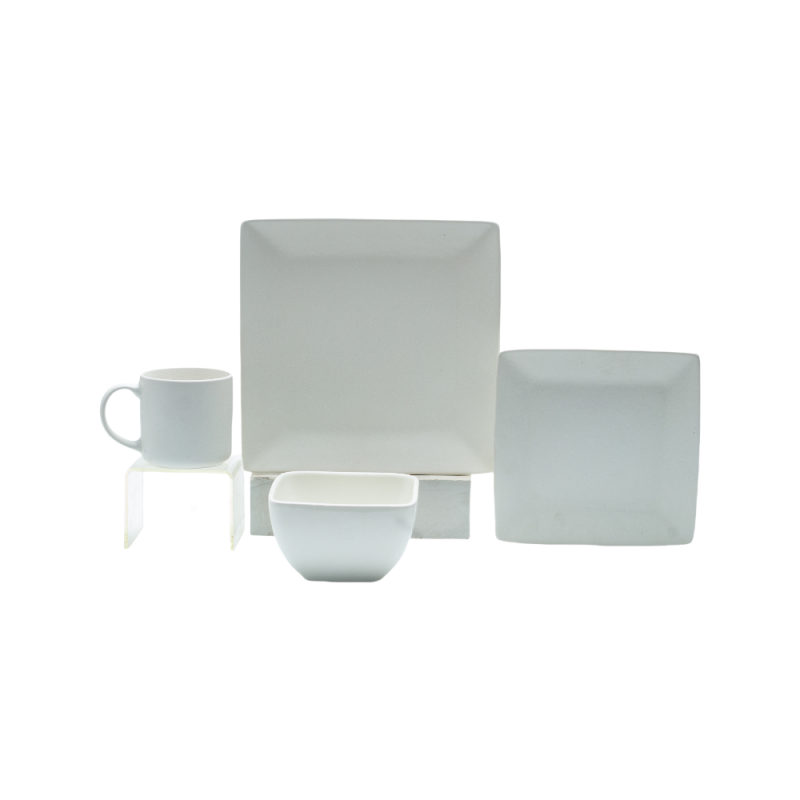
Products in this guide: Bone China Mug with Twisted Handle · New Bone China Espresso Cup Set
The property behind it has no column in an inspection report. Green strength is the integrity of the body before firing, when nothing has melted and the piece is held together by packing, water films and shape. It cannot be measured after arrival.
What follows is where it comes from, why two pieces from one body are not equal, the failures it produces, and what to put in writing. See the full ceramic sourcing process map.
A Body With No Glass In It
Unfired ceramic is particles with water between them. Clay platelets hold thin films that pull the particles together; the platelets slide, which is what makes the body formable. Nothing is welded and no glass bridges the grains.
Two consequences follow. Green strength is low next to the fired piece, so a wall that survives a decade of dishwashing can be broken by a thumb. And it depends on water in a narrow band: too wet and the body slumps, too dry and it turns brittle, chipping at the rim and fracturing where a tool touched it.
The strongest greenware is not the driest. It is the piece dried evenly to the moisture its body was formulated for.
Why Two Pieces From One Body Differ
A buyer who approves one sample and receives five thousand assumes the same material. It is the same recipe, not the same condition.
- Particle size. More fine fraction packs tighter and holds more water; coarser body gives water up faster.
- De-airing. Clay through a vacuum pug mill carries fewer air pockets, and an air pocket is where a crack begins.
- Ageing. Body rested after mixing distributes moisture; body used straight from the mixer carries wet and dry zones into forming.
- Forming method. A jiggered wall is compressed by the tool; a cast wall builds from the mould inward and stays softer near the base.
- Mould condition. A plaster mould near the end of its life releases water differently, so the same slip gives a different wall.
None of these is unusual. What matters is that they move, and that only one is ever written into a purchase order.
The Four Failures It Produces
Green strength rarely fails on its own terms. It fails as something else, downstream, where the cause has left the room.
The rim chip before glazing. A rim is the thinnest section and the first thing a hand touches. Where strength is marginal, chips appear at the finishing station rather than in the kiln.
The handle crack at the joint. An applied handle is a second piece joined to the first, and until the joint develops, the join is the weakest line in the object. Ware moved too soon gives handles that pass inspection and fail in the market.
The crack at trimming. Fettling removes material and applies force. A body slightly too dry will not deform under the tool; it fractures at the foot or below the rim, too fine to see until glaze pools in it.
The crack blamed on the kiln. A hairline opened in drying or loading does not close in the kiln. Heat opens it, glaze flows in, and it becomes a firing defect with a firing explanation. The kiln shows the evidence; it does not create the fault.
Drying Gives Strength and Then Takes It
Drying is described as the step that prevents defects. It also removes the strength the piece had.
Water leaving the surface pulls the body inward. If the surface dries faster than the core supplies moisture, the skin shrinks while the interior does not, and the wall carries a tensile stress. A small gradient is normal; a large one is a crack waiting for a reason.
Three things widen it: direct air across wet ware, uneven stacking so outer pieces dry first, and loading a rack before the piece has equalised. All three are cheap to fix and none appear in a specification. A piece dried past its intended moisture also loses the plasticity that absorbs a knock.
What a Factory Can Measure, and What It Hides
No buyer will measure green strength at the port. What can be measured is at the plant, without a laboratory.
Moisture at forming and at loading. Two readings, from a meter the plant owns or a control piece weighed wet and reweighed dry. Figures differ by body, so the useful reference is the plant own history.
Pre-firing loss, counted. Pieces scrapped between forming and kiln entry, per thousand started, is the most direct number available, and the least reported, because it never becomes a delivery shortfall.
A deflection check. A control piece supported at two points and loaded at the centre breaks within a narrow range for a given body and thickness. A plant recording its baseline sees a change before it becomes a complaint.
A first-piece check after every change. New body batch, new mould, new operator, restart after a weekend.
Inspection reports count fired, decorated, packed pieces. Anything broken earlier has left the population, so it cannot appear as a defect rate. It is absorbed into the unit cost and the schedule, and shows up as a supplier who is always slightly slower than another with the same equipment. The better question is not how many defects were found, but how many pieces were started.
What to Put in the Order
Green strength belongs in the specification as conditions, not as a test result. The spec freeze guide explains how artwork and packing files are locked between orders.
- the moisture range at forming and at kiln loading, stated by the plant for its own body
- a de-aired body requirement, with the method named
- minimum wall thickness at rim and handle section
- drying rules: no direct draught, rack drying in a defined order, a rest before trimming
- pre-firing loss reported per thousand started, as a trend rather than a pass mark
- nothing moved before the joint or the rim has reached the agreed condition
A supplier who answers these questions is describing a process; one who answers with a defect rate is describing an outcome that has already hidden its cause.
The crack that reaches the buyer is the last event in a sequence that began when the body was mixed. Strength before firing is where that sequence is decided, and it is the one part of the chain no inspection at the port will show.
Related Products
Explore products featured in this guide:


Have questions? See our Sizes & Finishes FAQ and Ordering & Certifications FAQ.
Need a custom quote? Send an inquiry or browse our full product catalog.